- 01.11.–20.12.2026
- Exhibition · Preview
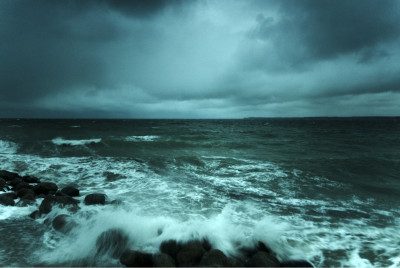
Jan-Peter E.R. Sonntag
Seestück 9190
Looking out across the water: an unnamed „Seestück“ (seascape) on a billboard on the quay wall next to the bridge at Wildenbruch. Between 1845 and 1850, the 10.3-kilometre-long Landwehr Canal was built here to transport building materials for the growing city of Berlin and to relieve pressure on the River Spree. At the same time, seascapes developed in marine painting – freed from the depiction of ships, shipwrecks or sea battles – into a modern type of image. The empty seascape and the canal in question are effects of the same thing: an expression of industrial-urban modernity. The canal that defines the presentation site, as a logistical equaliser of production and transport processes in industrialised urban development, is just as much an effect of the industrial-rational relationship to nature as the mere depiction of its surfaces, movements and forces – without mythological implications, without humans as acting subjects – in painting and photography. The empty seascape reflects the alienation experienced in an industrial society based on the division of labour. Both visually and acoustically, this motif runs like a leitmotif through Jan-Peter E. R. Sonntag’s oeuvre – from his early spatial works consisting of swirling fields of standing pressure waves and monochromatic light, to his psychoacoustic installations with endlessly rising noise and fog, to his video and photographic works. The photograph on which the multi-part large-format poster is based was taken at the turn of 2015, on a late afternoon in Travemünde, with an unusually strong north-easterly wind.
Jan-Peter E.R. Sonntag grew up in Travemünde on the Baltic Sea, attended the music department of the Johanneum in Lübeck, then studied fine arts, art history, composition, philosophy and cognitive science. He was a scholarship holder at the Akademie Schloss Solitude and Villa Aurora in Los Angeles, among others, and has received numerous awards, including the German Sound Art Prize. His predominantly spatial works have been shown worldwide at venues including Apex Art & The Kitchen, New York; zkm, Karlsruhe; ars electronica, Linz; WKV & Staatsgallerie Stuttgart; China Science & Technology Museum, Beijing; Elektra, Montreal; V2, Rotterdam; NIMK, Amsterdam; sonambiente, transmediale, tesla, Deutsche Bank Kunsthalle, Akademie der Künste, Savvy & TA T, Berlin; Fundacion Arte Y Technologie & 2021 as part of Audiospheres at the Reina Sofia, Madrid. In 2015, Sonntag had his first retrospective, Rauschen, at the WKV Stuttgart, and in 2017 he realised Rundfunk Aeterna – a radio opera commissioned by documenta 14.
Curated by Uwe Jonas
- Jan-Peter Sonntag